The Insurance Gap

“The bills come in a shovel and go out in a teaspoon,” says Khary A. Matthews, one of the 50 million uninsured nationwide. Credit: Yanick Rice Lamb/Fully-Connected.com

For three weeks, Khary A. Matthews has watched fellow patients come and go in a three-bed ward at Howard University Hospital, where he says he was recovering from a seizure and meningitis. Like 50 million people nationwide, Matthews is uninsured—a situation that could be eased under the Affordable Care Act.

Besides lacking insurance, Matthews knows firsthand that the unemployment rate for African Americans has been twice the national average. He was laid off from his teaching job at a charter school. He has reached the marrow of his “bare bones” budget.

“The bills come in a shovel and go out in a teaspoon,” Matthews says, quoting his grandmother. The 35-year-old actor cut back on plays and movies, sold his 2006 Audi, switched to public transportation and signed up for food stamps. “I’m not ashamed of it,” he said. “I’ve seen people with more degrees than me in line.”

The scary part was giving up his insurance. He said he paid about $30 a month for insurance through his job, but $400 under COBRA, the Consolidated Omnibus Budget Reconciliation Act of 1985, which allows temporary coverage under an employer’s group health coverage. Being sick worries him. He had another scare when he was hit by a car while riding his bike and ended up on the windshield. That’s when the seizures started, he said.

“I’ll be out grocery shopping, and I’ll find myself in the back of an ambulance,” said Matthews, who also blacked out on a Metro rail platform. He hopes to find a roommate who can double as a sentinel in case he blacks out again — and a job with benefits. In the meantime, a social worker is helping him apply for Medicaid coverage.

Some people can’t get insurance through their jobs. Studies show many can’t afford the premiums or they squeeze out coverage for their children, but not for themselves. Most of the uninsured are in working families; 61 percent have at least one person with a full-time job and another 16 percent have someone working part time, according to a 2010 analysis by the Kaiser Commission.

Among single people, the insurance gap is concentrated at the bottom but cuts across income. About 25 percent of uninsured singles earned less than $25,000 in 2008, reports Families USA. However, 8.2 percent took home $75,000 or more.

It wasn’t always this way. From 1968 to 1980, the majority of Americans under 65 had some type of private insurance. As more and more companies began to cut back on coverage, those with insurance fell from 79 percent to 67 percent in 2007, according to a half-century analysis by the National Center for Health Statistics. Employer-sponsored coverage dropped from 71 percent to 62 percent during this period. It’s now at 57 percent, the Kaiser Commission reports.Yanick Rice Lamb

Haile Gerima’s ‘Teza’ Available on DVD

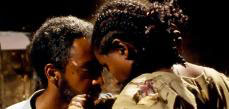
Aaron Arefe portrays Anberber in “Teza” by Haile Gerima. The Ethiopian filmmaker’s 11 movies also include “Sankofa.” Credit: Mypheduh Films

Action. Romance. Historical facts. Humor. “Teza” has it all. Ethiopian-born filmmaker Haile Gerima spent 15 years preparing “Teza,” which is narrated in Amharic with subtitles in German and English.The film, which received widespread acclaim internationally, is available on DVD.

The story is told through the eyes of a man named Anberber, played by Aaron Arefe. Anberber is a passionate young man who grew up in Ethiopia, but left to study medicine in Germany during the regime of Ethiopian dictator Haile Mariam Mengistu.

While in Germany, Anberber grows as an intellectual, finds and loses love, and builds life-long friendships. Yet, in the end, he remains loyal to his country and returns to his homeland in hope of curing the sick and making a difference in Ethiopia.

“I try to marry cinema with my culture,” explained Gerima, who has made 11 films including “Sankofa,” also the name of the Howard University professor’s film, video and bookstore café in the heart of Washington, D.C., on Georgia Avenue.

“Teza,” which has breathtaking scenes of Ethiopia, has won numerous awards. At the 65th Venice Film Festival, “Teza” was awarded the Special Jury Prize and the OSELLA for best screenplay. It also won the 2008 Cinema for UNICEF Award.

At the 2008 Arab-African film festival of Carthage, Tunisia, the film swept away five awards, including the Tanit d’Or for the best film. It was also awarded the Golden Unicorn for the best feature film at the Amiens International Film Festival in France and won prizes at the 2008 Dubai International Film Festival and 2009 Rotterdam International Film Festival.

“Teza” was first out of 128 films at the 21st Pan-African Film and Television Festival (FESPACO) in Ouagadougou, the capital of Burkina Faso.—Jasmine Norwood

Lyrical Language

Somali-Canadian artist K'naan. Credit: knaanmusic.com

Keinan Abdi Warsame, better known as K’naan, had people around the world literally “Wavin’ Flag(s)” to the No. 1 single that raised fan fever during the World Cup as well as funds for victims of Haiti’s earthquake. Mitt Romney even used the song as he claimed victory recently in Florida’s Republican primary’s camp. K’naan put a stop to that since Romney didn’t have permission and wouldn’t have gotten it if his camp had asked.

Keeping his collaborations out of politics, the Somali-Canadian singer and rapper has performed with everyone from Metallica guitarist Kirk Hammett to Mos Def. His latest EP, “More Beautiful Than Silence,” features Nelly Furtado and Nas.

Another View of Kony Campaign

Roughly 100 million people saw the “Kony 2012” clip that Invisible Children posted on YouTube in early March, making it one of the most viral videos ever. “Joseph Kony, the Ugandan warlord and leader of the Lord’s Resistance Army (LRA), recently gained a sudden fame which he probably would have preferred to do without,” Cameroonian freelancer Julie Owono writes in a commentary for Al Jazeera. “He became the No. 1 enemy of Internet users around the world.”

While Owono, a Paris-based international relations consultant, believes that Kony “must be brought to justice,” she and others find fault with the campaign.

“The propaganda used by the organization to ‘raise awareness’ is highly questionable, and allows dangerous and misleading messages to be spread,” Owono contends. “One such message is that the African continent, and, in this specific case, the northern part of the Great Lakes region, is a playground where international law and respect of sovereignty have no place.”

The Black Dollar Today

For the love of money? Credit: Creative Commons

Even in a recession, black America’s spending power is robust in several economic sectors. We will explore and attempt to forecast where the dollars are going.