
Geography Is Destiny When It Comes To Enrolling In Health Insurance Exchanges
By JENNY GOLD
KHN Staff Writer
OCT 13, 2013
This KHN story was produced in collaboration with 
Alexandra Dixon threads her way among the people waiting to see a doctor at the Community Clinic, Inc. in Silver Spring, Maryland. She introduces herself with a bright smile and an outstretched hand: “I’m one of the new health care navigators. Have you heard of the Affordable Care Act?”
While some folks mumble, “um, no I don’t think so,” Dixon is nonetheless booked up with appointments. She’s one of 350 people in Maryland who have been hired and certified to help consumers enroll in the new health insurance options that are offered as part of the health law.
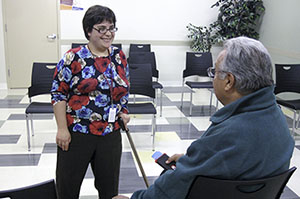
 Navigator Alexandra Dixon discusses insurance options with Alex Compagnet at Community Clinic, Inc., in Silver Spring, Md. (Photo by Jenny Gold)
She says that a few frown at what they call “Obamacare,” but “for the most part, people have been really excited and really happy and know what this is, you know.”
Dixon sits down with Maria Hernandez, a construction worker who’s a legal immigrant and has been uninsured for the past five years. Hernandez says sometimes she gets sick, but without insurance, it’s better just to take some medicine and stay home. With Dixon’s help, she’s gotten an application started for insurance.
Despite Dixon’s enthusiasm and persistence, no one at the clinic where she works has actually enrolled in a new private insurance plan on the exchange. The Maryland exchange website freezes up at some point in the process almost every time. But whenever Dixon hits a road block, she just sets up an appointment for the patient to come back: “Because the portal is a lot better this week than it was last week. I have every expectation that next week it will be working better than this week,” she says.
And she has her state behind her—Maryland has embraced the health law. It’s one of the 16 states plus the District of Columbia that are running their own exchanges. The rest are being run by the federal government, whose efforts have been stretched thin, according to Caroline Pearson of Avalere Health, a consulting company that’s been tracking exchanges.
“The states that are operating their own exchanges just have a lot more funding available to do outreach and enrollment. The federal government just had limited funding left to do that, and it was spread across a large number of states,” she notes.
The entire state of Ohio, for example, got just $3 million in grants to do consumer outreach. That’s compared to $24 million in Maryland, which has half as many uninsured residents.
That frustrates Lisa Hamler-Fugitt, who runs the Ohio Association of Foodbanks, the state’s main consumer outreach group for the exchange. “We have too few boots on the ground,” she worries. “We need hundreds if not thousands of individuals to assist us.”
Instead, she’ll have about 40. Ohio has laws putting additional restrictions on navigators, including requiring them to go through a longer certification process with the insurance department. Hamler-Fugitt believes that’s stalled the process of getting her navigators on the ground by three weeks. These early differences between states could hamper the goal of the ACA, which is to get as many people insured as possible, according to Avalere’s Pearson.
“Recent polling show that only about 12 percent of the uninsured population, who could benefit from exchanges, understand that they are launching and began on October 1st. So doing a big push out in the community can potentially bring a lot of people into the market, that you’re not going to see in a state that isn’t as proactive,” she says.
But she adds, this is only the beginning of the enrollment process. And launching a program of this size is always a huge lift. Consumers have until the end of March to sign up for coverage in 2014. And as the kinks get worked out, it’s still possible that this year’s enrollment will be a success.
Transforming communities in Brazil with cell phones
By Caroline Sainsard
Salvador da Bahia, Brazil – August 31, 2013
On July 31, the VOJO project, a communication training program for young people in isolated black communities, began in 9 quilombos (communities created by freed slaves) near Salvador, Brazil.

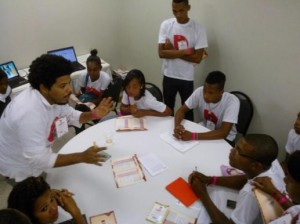
Twice a week, members of Midia Etnica takes a bus, a shuttle and then a boat to give a VOJO training to more than 20 young people ages 16 to 30. Once the classroom settles, the training starts. Beyond the VOJO project, a lot of themes are tackled with the participants: communication, of course, but also government and human rights. The young people learn how to express themselves and to be self-confident doing it. Class after class, they feel more and more convinced that they can be respected and highly regarded sources of information. After several weeks of VOJO training, they begin to broach topics such as education, security, health, and pollution, among other more local issues (like exceptionally high tide or road construction). None of them misses an opportunity to give his or her opinion.
That is why the community expects so much from the VOJO project. “We want our kids to help us to defend the communities’ rights and interests”, explains Eliete Paraguassu, the local organization manager. “By taking part in this project, they get to know each other better and, later, will be more inclined to work together as a strong team. Plus, Midia Etnica, through the VOJO project, helps us to make them responsible and give them a political conscience and a social presence. This is really important for the future of our nine communities.”
The young people already perfectly understand their interest in the VOJO project. Coming back from school, two of them heard that the boat fee they pay daily to go to school would increase. Furious, they dialed the VOJO number to record an interview with the boat’s owner. “We wanted to know more about it and share the information. Most people here did not know anything about this fee. It ended up that it increased because of the municipality… People should know that, shouldn’t they?” asked Laura, one of the youngest interns.
As the training finished, the young people got ready to use the concepts they learned by participating in the Third Interstate Promoting Racial Equality Conference. There, they interviewed local leaders and told them what they expected from them – a good way to use the VOJO technology and to concretely realize its potential.
What’s the next step? The young people hope to get one computer for the 9 communities and learn how to edit the news they record. In doing so, they will become the perfect actors to spread the VOJO technology to other isolated places, contribute to broadcasting minorities’ perspective, and who knows, maybe even use the skills they acquired to find a respectable job… a dream of theirs.
What is the VOJO technology?
You don’t have Internet but you have plenty of things to broadcast? The Center for Civic Media of MIT, a prestigious university in Boston, created an amazing technology: VOJO. With only a cell phone, you can broadcast news on the Internet. Dial the VOJO phone number, press 1 and record what you want to be broadcasted. Once you finish, press # to send it to a main website. Your content is available to everyone online. You can also send photos by text message.
Correio Nagô is a news portal created by young Black communicators from Mídia Étnica. It aims to combat economic and racial exclusion and discrimination that still exist in Brazil by encouraging a collaborative participation by its large readership via its website and creating a network of news sourced throughout Brazil and the world.
Another mission of our social nework is to establish a news channel about Black culture – helping to diffuse content produced by different communities and activist groups from the Black Movement
The Correio Nagô is another project of the Mídia Étnica Institute – www.correionago.com.br
E-mail: redacao@correionago.com.br
Reprinted by permission from Correio Nago.
More info here: https://www.facebook.com/
Egypt Into the Abyss
 By Sunni M. Khalid
In the 61 years of Egypt’s republic, through four conventional wars with Israel, decades of military dictatorship and emergency law, waves of political repression and economic stagnation, there had never been a day like Wednesday, August 14,2013 – a date that shall remain forever etched in Egypt’s collective psyche.
At dawn, Egyptian security forces laid siege to the Rabaa al-Adawiya Mosque in east Cairo’s teeming Nasr City, one of two redoubts for supporters of ousted President Mohamed Morsi. When the security forces, some wearing black hoods, using high-powered rifles, tear gas, bulldozers and armored personnel carriers, were finished, anywhere from 700 to more than a thousand people – including women and children – lay dead, with thousands more injured. Until then, no Egyptian government had ever slaughtered hundreds of its citizens in its streets in a single day.
Perhaps 10 times more people were killed or injured on the streets of Cairo in one day than were killed or injured during the three weeks of protests to oust Mubarak in 2011, or about the same number of people who died during the low-level Islamist insurgency that swept Egypt in the 1990s.
If there was ever any doubt about where Egypt’s star-crossed path to democracy stood, all one had to do was look at the carnage and charred tableau on the streets around Rabaa al-Adawiya. Or at scores of Coptic churches, police stations or government buildings in Cairo and elsewhere, or the presence of heavily-armed police, soldiers and tanks.
Egypt is not ruled by figurehead president Adly Mansour, the colorless, bespectacled judge plucked seven weeks ago from the constitutional court. No, the man calling the shots is Defense Minister, Gen. Abdul-Fattah Al-Sisi, 59, the same man named by Morsi last year to lead Egypt half-million man army. The 62-year-old Morsi, Egypt’s only democratically elected president, is being held incommunicado seven weeks after his ouster.
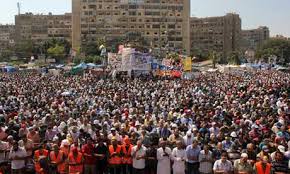
Yet it is Morsi’s aborted presidency that looms over Egypt’s democratic experiment and has fired continuing mass protests all over the country by tens of thousands of his Muslim Brotherhood supporters. Al-Sisi has promised that a new constitution will be drafted and presidential elections within six months. But after last week’s massacre, the question is not whether Egypt’s rollercoaster ride toward democracy will continue, but if the Arab world’s most-populous nation will fully descend into civil war, a chilling possibility in a region that has seen bloody, protracted internal wars in Algeria, Lebanon, Yemen, Iraq, and Syria.
As Egyptians look with trepidation towards the future, they face a rather narrow set of sobering choices. There is the current perpetuation of the secular authoritarianism under the Army, or a return to the near chaos of a return of political Islam, as witnessed briefly under the inept Morsi. Either option appears likely to be played out over years, promising the kind of political and social instability that can only damage Egypt’s teetering economy even further.
Scholars and pundits have often argued Egypt’s unstable mix of overwhelming poverty, high population density and widespread illiteracy simply don’t provide a secure enough foundation for Western-style democracy. But even detractors were stunned by the sheer enthusiasm with which large numbers of Egyptians who went to the polls to cast ballots in the last two years of elections.
In the end, however, it was not the electorate that failed Egypt, but those they elected. The Muslim Brotherhood’s Freedom and Justice Party, as well as other Islamist parties, which did not initially join the demonstrations to topple dictator Hosni Mubarak two-and-a-half-years ago, dominated the early polls and used their parliamentary majority to ram through a constitution that secular leaders, feminists and others objected to.
The showing of the Brotherhood should have come as no surprise in a country where religious piety has increased dramatically. While banned from politics for some 50 years, the Brotherhood had existed as a social welfare organization, winning the hearts and minds of millions of Egyptians with food, charity and its message of faith. Their decades of organization gave them a decided advantage against nascent secular parties, once the ban on their political activities was lifted in 2011.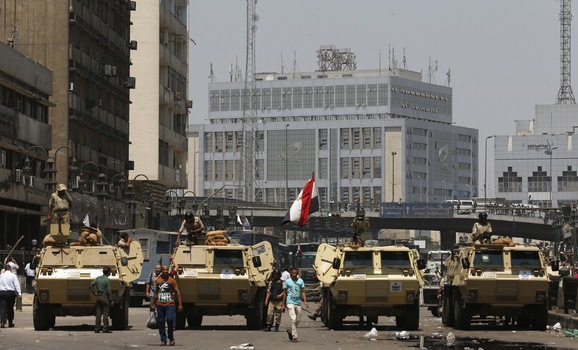
But the current crisis is not simply a political contest. If it were, the Brotherhood’s estimated 350,000 members would no doubt prevail against any other rivals, but their foe is the Egyptian military. But the Brotherhood squandered its opportunity to rule, as well as the sympathy of many Egyptians. And now they face an old foe that has stood in their path to take power for 60 years, the Army. With a half-million troops, the Egyptian Army is the largest armed force in the region and has unquestionably been in control since the charismatic Gamal Abdel-Nasser and the Free Officers overthrow the effete King Farouk in July 1952.
The Army controls a significant part of the Egyptian economy, with some estimates ranging as high as 40 percent. It’s senior officer operate hotels, resorts, banks, factories and construction companies. The Army rebuffed calls to be put under civilian command and its budget is also beyond civilian scrutiny.
True authority in modern Egypt rests in the use of force, or the mere threat of using it. Since the state has usually controlled a monopoly regarding force, it has been able to demand the respect of most Egyptians. Only the most fanatical have ever violently challenged state institutions. Nearly all, including the Brothers in the 50s and 60s, have been ruthlessly crushed. For those who do not challenge the state, most Egyptians are allowed to live their lives without too much interference –a prescription for enforced tranquility in far too many nations. In the past, that was enough to ensure stability for decades.
But Egypt and Egyptians truly did change in January 2011. Not only did Egyptians mount non-violent protests to overthrow a dictator, but also then subsequently installed an inept elected civilian head-of-state. They have tasted political freedom and it remains highly unlikely that either the Muslim Brotherhood, or their secular opponents, who have applauded Morsi’s ouster and last week’s crackdown against the Brothers, will stop agitating for genuine democracy, not a pale facsimile promised by the Army.
The very idea of a government that is directly accountable to its people is something that paternalistic government officials repeatedly told me the Egyptian masses were not “ready” for. Egypt’s leaders, including Morsi acted as if they genuinely believe that they alone knew what is best for the nation. The country is too poor, so the justification goes, that its people are too uneducated and backward to exercise their rights in a full democracy. Perhaps, so the canard continues, at some undetermined date, far off in the future, the Egyptian electorate will be “mature” enough to exercise full democratic rights.
But the time has passed for such arguments. Egyptians are impatient for change. And assurances by a military that has discredited itself after decades of misrule will not be able to satisfy very many of Egypt’s 85 million people.
Already, the Brotherhood, with much of its top leadership in jail or on the run, has regrouped, mounting more mass protests and vowing to continue its campaign to have Morsi reinstated, no matter how seemingly unrealistic. The Army appears in no mood for negotiation and retains its monopoly on power. And, in the middle, are the Egyptian masses, who long for peace and stability above all else. The time is not yet ripe for compromise and may not be for some time.
Like never before, Egypt is perched precariously on the ledge. Either its leaders will be able to guide the nation through the current crisis and regain the momentum of the march towards democratization, or selfishly plunge the nation into an abyss of a bloody civil war, with widespread economic deprivation and instability that may consume not only Egypt, but the rest of the Middle East and, indeed, parts of Europe and the United States as well.
Sunni M. Khalid is a veteran journalist, who was based in Cairo for three years.
Ganging Up

A group of rival crews shot up a funeral procession in Washington, leaving one dead and two injured. Untold innocent bystanders are caught in cross fire intended to settle beefs. Gang activity has also shaken cities around the world from Chicago to Capetown, South Africa.
What’s being done to combat this problem? FullyConnected.com looks at funding over the years, efforts by leaders such as President Obama to control guns and various initiatives — those that seem to work and others that didn’t. This will be an ongoing, multi-part series. We will seek to involve at-risk youth who will compile video diaries. How better to see it up close and personal than employing teen journalists who are close to the action.